Do You Need to Let the Controller Know When You Change Altitudes if You Are Doing Vfr-on-top
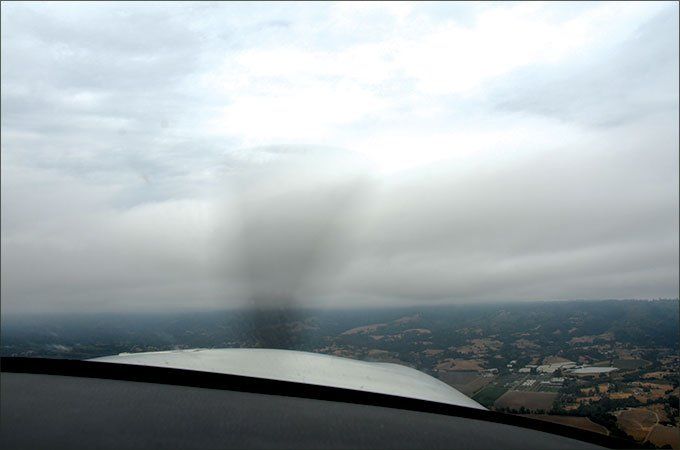
There are really ii pieces to this. There'southward the clearance to maintain altitude "VFR-on-top" itself, but there is also the variation mentioned in "Tame the Fog Monster" concluding month, the IFR departure to VFR-on-top. Both are useful tools that deserve a closer expect.
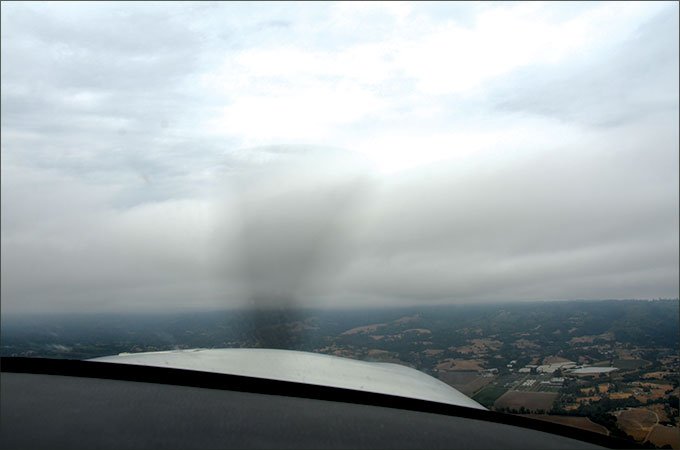
Since VFR-on-superlative is the key piece, we'd amend define it. In the simplest course, think of VFR-on-top every bit clearance requested by yous in lieu of a hard altitude, where you lot can pick your VFR altitude while maintaining VMC on an IFR flying programme. At that place are other nuances we'll get into below, only VFR-on-top as an IFR altitude consignment is the gist of it.
Your IFR Escape Programme
Given the fickle nature of marine layers, I've often expected to depart VFR only to exist faced with a depression ceiling. Rather than taking the fourth dimension to file a full IFR flight program, the "IFR to VFR-on-summit" clearance solves the need. It's a truthful IFR clearance that allows an aircraft to make an IFR climb through a cloud layer or other obscuration to VFR weather condition. You typically don't accept to file in the normal sense. Ordinarily all information technology takes is a quick asking to the appropriate ATC facility.
Now, when I say "usually all it takes" I'm referring to a location that's non horribly busy. If you're departing a Class C airport that lies in the shadow of an overhanging Class B, yous might be better off both from a clearance availability standpoint and for fourth dimension efficiency to file IFR every bit you normally would and just cancel—if y'all wish—when you reach suitable conditions.
Once you lot get that clearance and launch through the muck, upon reaching VMC there are iii options. You lot can abolish IFR service and continue VFR with flight following, with the normal "workload permitting" caveat. Or, you can cancel ATC services entirely and proceed VFR. But if you lot desire the benefits of IFR only no altitude constraints there is the selection of continuing "VFR-on-top" equally your just altitude clearance.
By the style, don't be confused with "VFR over the acme." This is but a VFR flight that departs, cruises and lands in VMC, but might be flying over an undercast en route.
How To
When you're ready to depart through an overcast to known VFR atmospheric condition above the overcast (meet sidebar on SkewT), enquire for "IFR to VFR-on-superlative" and land the desired direction of flight or destination. This will typically elicit one of ii basic clearances.

The start is but a clearance to climb to VFR-on- height. "Climb to and report reaching VFR-on-top. Tops reported one thousand 8 hundred." or "…No tops reported." It would be unusual for the controller to give you an unlimited clearance like that without knowing the tops, so the clearance may incorporate restrictions.
If the controller doesn't know the tops or there is another need to restrict you in some style, such as for traffic avoidance, you lot may go some restrictions in the clearance, including a clearance limit. "Cleared from the Watsonville airport to the Salinas VOR via direct. Climb to and report reaching VFR-on-meridian. No tops reported. If non on top by five g, maintain v thousand and advise." As e'er, your clearance may or may not contain specific departure instructions such as an obstacle deviation procedure. If not, be sure to choose a prophylactic departure routing.
Note that your clearance limit is a VOR. This is mutual, especially if the controller knows the weather at the VOR is VMC and clear of the layer you were trying to escape.
Once you reach VMC, notify ATC that y'all're on superlative and abolish IFR if you wish. If you want to remain on your IFR clearance, but report reaching VFR-on-pinnacle and you'll receive the follow-up clearance, "Maintain VFR-on-elevation." If you accomplish the clearance altitude limit and are yet IMC, suggest ATC and together you can work out your Plan B.
If you aren't certain that you can climb to VFR conditions by a reasonable altitude you're probably amend off filing a total IFR flight plan that includes a destination—possibly a nearby aerodrome or even your departure aerodrome—so you'll have a destination if you lose communications.
If you go NORDO (FAA jargon for "NO RaDiO") at whatsoever point and you're in VMC, maintain VFR, squawk 7600 for one minute to bespeak communications loss, and so squawk 1200 to let them know you're maintaining VFR. Land at the nearest suitable airport—I'd prefer a non-towered airport—and contact ATC.
If you're still IMC and lose your radios, the IFR lost communications rules may not assistance much, primarily considering your clearance limit is probably a VOR or some other user-friendly fix, not an airport. At this bespeak yous're going to have to apply your judgment.
I'd squawk 7600 for one minute to notify ATC I'm experiencing lost communications, and and then 7700 to betoken that I'm declaring an emergency. In this social club I would then either go to the nearest airport with VFR weather, the nearest airport with atmospheric condition conditions conducive to a low-stress instrument arroyo, or finally, the nearest airport with an acceptable arroyo of any blazon.
Remember, though, you lot must have the weather condition and approach information to brand that emergency decision before y'all take-off. One time you lot have a consummate loss of communications it may be too late to figure out the weather at your various airport options. Don't forget satellite weather if you have it. Information technology may non be electric current, merely it's amend than zip.
If your plan is only to accomplish VMC with the intent of continuing VFR, one thing that might assist get a quicker clearance is to tell ATC during the initial request that you're planning to cancel services once reaching VMC. That reduces their ongoing workload and might expedite the clearance. If you desire flight following, ask for information technology during your initial asking. If you're planning to apply VFR-on-acme for the balance of your flight, it's better to file a full flight plan with the complete routing and the note "VFR-on-top" in the remarks section rather than trying to get a pop-upwardly IFR clearance.
As you climb through the tops to VMC go on in listen that the natural inclination is to cancel IFR as yous intermission into the clear. Don't. You must maintain the basic VFR cloud clearance requirements of 91.155. For most airspace this is 1000 feet above the clouds, and so if you tin't remember the specifics, annotation the distance of the cloud tops and make certain that y'all've climbed at least an additional 1000 feet earlier canceling IFR. If ATC didn't know the tops or they're different than ATC stated, give the next pilot a leg upwards and provide ATC with a bases and tops study.
VFR-On-Top
If you decide to continue VFR-on-top, fifty-fifty though it's officially an IFR clearance you are responsible for flying at the correct VFR altitudes per 14 CFR 91.159. However, you're free to choose and modify to any VFR altitude equally long as you don't become beneath the MEA. In addition, you're responsible for flying with the appropriate cloud clearance and inflight visibility. You likewise have the primary responsibility for traffic avoidance and wake separation, although ATC will typically provide assistance as they do for flight following.
The flip side is the necessity to too operate nether IFR regulations like minimum IFR altitudes, following your assigned route, required position reporting, adherence to all clearances, etc. Normally y'all're also requested to requite ATC at least a one minute alert before changing altitude so they can coordinate with other sectors or shipping.
So, with all the extra restrictions, why choose VFR-on-peak? It provides almost of the benefits of IFR services, but with potentially greater flexibility, especially in terms of altitude. You tin request VFR-on-superlative in lieu of a specific altitude assignment on any IFR clearance.
A pilot might choose VFR-on-top when IMC en road in or about the deject tops, icing conditions or whatsoever time yous just demand a little more than distance flexibility. IFR at, say, 7000 could be in the tops and icing, only VFR-on-meridian at 7500 could be all you lot demand. A few hundred anxiety can be plenty to brand the difference, and then you don't demand a 2000 foot alter to the next IFR altitude.
Y'all might prefer a slower descent than you can get from ATC—you or your passengers have ear or sinus problems or to avert engine shock cooling, for instance—a VFR-on-pinnacle clearance can allow you lot to choose a descent point and rate to suit your needs. You only can't descend below the MEA.
I've used a VFR-on-top clearance to go effectually an area of cloud buildups. I was tired of waiting for a clear second on a frequency already overwhelmed with departure requests. Getting VFR-on-top with a cake altitude and the notification that I would be deviating around buildups allowed me to deviate and climb or descend within the block distance as necessary. I still had to maintain VFR cloud and visibility requirements, simply being responsible for my own traffic separation made the controller's task easier and he gave me more liberty to deviate. Y'all might not e'er get this much freedom, but yous certainly won't if you don't ask.
In general ATC is more inclined to allow flexible routing, especially in less decorated airspace, considering the pilot has responsibleness for traffic avoidance. There are no guarantees, of course, only when VFR-on-meridian information technology may be possible to get a routing that wouldn't be available at an IFR distance. This can fifty-fifty come in handy if you're flying over a scenic area you'd like to encounter a chip more closely.
One more benefit of being VFR-on-top is that since y'all're even so on an IFR flight plan, you can't get dropped like ATC sometimes does with flight following. You lot might file VFR-on-tiptop if your destination is in decorated or complex airspace. This allows yous to relax for the bulk of the trip and when yous're nearing the destination it's very easy to get fully back into the IFR system by but telling ATC that y'all're canceling VFR-on-pinnacle and requesting a specific IFR distance consignment.
Good Stuff
Just considering information technology's chosen "on-top" doesn't preclude operations below or between layers or even in severe articulate weather. The but requirement is that the weather at least allows you to maintain the VFR deject clearance and visibility requirements of 91.155. Also, an "on superlative" clearance isn't available in Class A airspace and in selected restricted areas.
At that place are a few tricks in the IFR toolbox that are seldom used, and VFR-on-height is one. Notwithstanding, like others, it has a place when properly practical. An IFR to VFR-on-top clearance can be the easiest way to escape an aerodrome that'due south in IMC but with VMC nearby. One time underway, VFR-on-top permits more flexible en route options with the ability to speedily resume full IFR as atmospheric condition, the destination or your psyche may crave, including getting sequenced into your turn for that ILS to mins at your destination. VFR-on-top is a useful tool to proceed in your pocketbook of tricks.
Briefing with SkewT
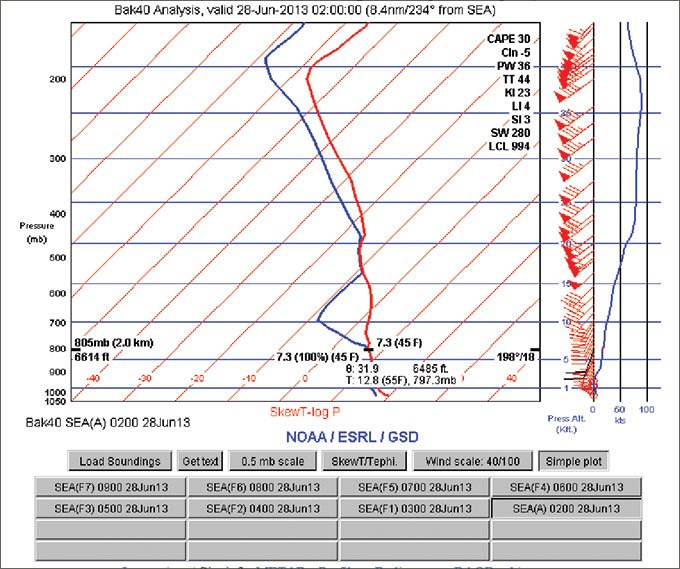
When planning a flight, I expect for cloud bottoms, deject tops, layers, freezing level, wind direction and speed. SkewT charts (rucsoundings.noaa.gov)are one of my favorite conditions conference tools. They are computer generated forecasts for drome locations, derived from weather balloon soundings.
I tin tell at a glance where the layers are and where it's clear. With the added do good of freezing level and winds, this offers a wealth of valuable data when planning any difference.
Projections over several hours, help me confidently programme IFR flights, or cancel with better understanding of the unfavorable conditions aloft. I use SkewT with other weather data (NOAA' ADDS, Satellite, Radar, DUAT(S) Briefings, etc.), to get a total moving-picture show of the weather earlier making my become/no-go decision and before making my concluding routing choice.
The red line shows temperature and the blue line shows dew point. Where these lines converge (from lesser-up) shows the deject bases and where they diverge shows cloud tops. The diagonal scale is temperature. Merely follow the zero caste line up to the electric current temperature for freezing level. Wind speed and direction are shown on the right. —George Flutas, CFII
The fundamental California coastal clouded requires Joe Shelton to asking IFR to VFR-on-acme far more often than he'd similar.
Source: https://www.ifr-magazine.com/technique/on-top-of-the-world/

Enregistrer un commentaire for "Do You Need to Let the Controller Know When You Change Altitudes if You Are Doing Vfr-on-top"